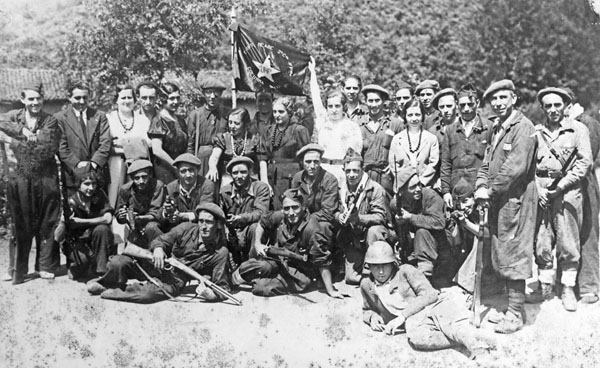
“How we went to War” [group portrait], Spain: 1936-1938. Source: Library and Archives Canada/Mackenzie-Papineau Battalion collection/e007151977
The First Volunteers
Hundreds of foreign volunteers were fighting in Spain prior to the formation of the International Brigades – mostly in Barcelona in the workers militias although there were also enough foreigners in the Republican forces to be formed into small units by nationality and attached to regular Spanish units. These were mostly in the Quinto Regimento organized by the Communist Party of Spain. In August of 1936, the Party held a meeting at Aranjuez to discuss the possibility of organizing an International Brigade. This was formally agreed to at a Comintern meeting on September 8, 1936. The Comintern (or Communist International) was a globally-focused organization run by the Soviet Union.
Tim Buck and Canadian Recruiting
Tim Buck had participated in the Aranjuez meeting. On his return to Toronto he met with the Communist Party of Canada Central Committee where a plan to enlist volunteers was agreed to. The Communist Party of Canada became the principal recruiter in Canada. It was, however, not the sole organization publicizing the cause of the Spanish republic. The Committee to Aid Spanish Democracy was the main fundraiser for the cause and the Communist Party was one of the many organizations covered by their umbrella. While the Communist Party was the main recruiting force, you did not have been a communist to volunteer in Spain. Anyone who was not a Trotskyist was welcomed to volunteer and about 20% of the Canadian contingent were non-communists.
Local recruitment committees were rapidly established. By April 1937, about 500 volunteers had been enlisted. In that month however, the Canadian Government, following the lead of the United States, passed the Foreign Enlistment Act. The act made participation by Canadians in a foreign military service illegal and, while no country was specifically mentioned, it was clearly directed at the recruiting for Spain. Recruitment continued, but it went underground.
In early summer, Prime Minister Mackenzie King travelled to Germany, meeting with Hitler and other members of the Nazi Party. He wrote in his diary about the favourable impression they had made on him. Returning to Canada he would strengthen Canadian Government opposition to the recruiting for Spain, ordering that all Canadian Passports issued after August 10 would be invalid for entry to Spain. This did not stop recruiting or travel to Spain, it simply made things more difficult.
November 1936
First Major Action: The Battle for Madrid
The story in Canada was paralleled in other countries. The XIth International Brigade was quickly formed in the fall of 1936, mainly from German and French volunteers. The rapid formation of the XIth Brigade reflects the common border with France and the speed with which French volunteers could enter the country. This was also true for many of the German volunteers who were already in France, having fled Nazi Germany.
The XIth fought with heavy losses in its first major engagement – the Battle for Madrid – losing about half of its 2000 men in fierce building-by-building fighting on the University grounds at the northeast end of the city. Despite the heavy losses, the brigade held its ground. The impact was enormous. The Nationalist forces were the elite Army of Africa units and previously thought to be invincible. The fact that they could be held back was of great importance for the morale of the Republican forces.
New brigades were formed in December 1936, the XIIth and the XIVth brigades with volunteers from France, Poland, Belgium and Yugoslavia. They were also thrown into the battle for Madrid as a new Nationalist offensive opened. These volunteers suffered high casualties, but they too helped to stop the new advance.
February 1937
The XVth International Brigade and the Battle at Jarama
By February 1937, the XVth International Brigade was formed, consisting of the Slavic-based Dimitrov Battalion, the British Battalion, the American Lincoln and Washington Battalions and the French 6 of February Battalion.
Canadian volunteers were arriving in increasing numbers. They would travel to the south of France (their passports were stamped “not valid for travel to Spain”) where they would be escorted by guides over the Pyrenees mountain range. Once in Spain, they would make their way to Albacete, the headquarters of the International Brigades for training and assignment to specific battalions. The increasing Canadian contingent was assigned to the Lincoln Battalion as were many volunteers from Latin American countries.
The XVth Brigade was formed in time to oppose a strong Nationalist offensive south of Madrid in the Jarama valley, one of the most famous battles of the war. The Nationalist force included the airborne German Condor Legion as well as two heavy machine gun battalions and a huge supply of German tanks and artillery.
Three International Brigades took part: in addition to the XVth there were also the now veteran XIth and XIVth. It was the first major engagement for the two American battalions in the XVth Brigade and for the Canadians assigned to them. The three International Brigades were slowly forced back with heavy losses. The British Battalion lost half of its men in a single engagement at “Suicide Hill”. But the attackers also took heavy losses and Franco was unable to make a strategic breakthrough. For many Canadians the Battle of Jarama was their first action.
A song about the Battle of Jarama by Alex McDade is in the Poetry and Speeches section.
April 1937
A New Battalion?
In April 1937, a number of Canadians got together to discuss the possible formation of a Canadian Battalion within the XVth International Brigade. The name they proposed was the Mackenzie-Papineau, after the English and French leaders of the 1837 rebellions against undemocratic British colonial rule in Upper and Lower Canada.
Throughout the spring volunteers were regularly arriving at Albacete and a new battalion was formed. The Americans, however, wanted it to be named as a third American Battalion (in addition to the Washingtons and the Lincolns). Their hope was that with three battalions in the field, they could form an American brigade. As compensation to the Canadians, who would not then see their own brigade, they offered to provide an all-Canadian company within the newly formed Battalion.
The Canadians mustered a number of arguments in support of their own battalion. There were now over 500 Canadians in the field, about half as many volunteers as the United States, despite the fact that Canada only had about one-tenth the population of the US at the time. There was also the argument that a Canadian Battalion would help to publicize the war back home and aid in raising increased public support.
In the meantime, the newly formed and still unnamed battalion continued to train. The reason for the delay in naming is not known, but it allowed the Canadian arguments to the International Brigade Command to proceed, and the Canadian proposal was adopted by the Brigade command.
June 1937
The Mackenzie-Papineau Battalion (The Mac-Paps)
A.A. MacLeod, who had travelled to Spain to arrange for the return of Norman Bethune, subsequently travelled to Tarazona in June to address the massed Canadians and Americans of the new battalion. He spoke movingly for two hours citing the founding of Canada, the War of 1812, the Rebellions of 1837 and the present situation in the world. Those who heard him were roused by the speech and when asked if they would endorse the new battalion name, the Mackenzie-Papineau Battalion (Mac-Paps), did so unanimously, including the Americans who were not unhappy about the new battalion – they thought the Canadians deserved it.
The new battalion was not entirely Canadian at that point – in fact Americans outnumbered the Canadians in the Battalion by two to one. As new recruits continued to arrive in Albacete from Canada they were usually assigned to the Mac-Pap Battalion, increasing the battalion’s Canadian numbers. Even with these new volunteers, however, Canadians typically accounted for about half of the members of the Battalion.
Many Canadians ended up in other Battalions. Some entered the Slav Battalions where they felt more comfortable because of similar languages. Others entered artillery batteries, transport units, or medical units. Many were killed or wounded in the Canadian section of the Lincolns before the Mac-Paps were formed and many continued in the Lincolns. Nonetheless, the Mackenzie-Papineau Battalion became the symbol of Canadian participation in Spain and remains so today.