The Spanish Civil War

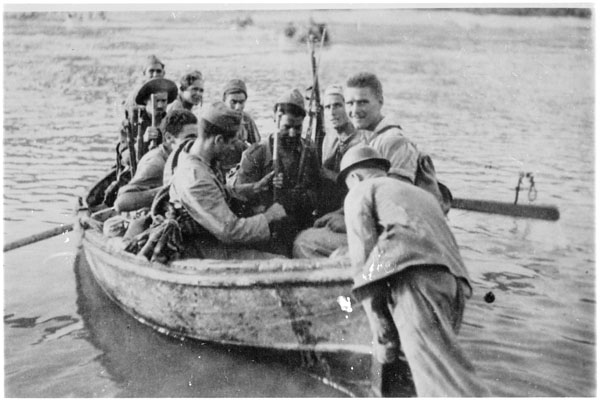
Members of the Mackenzie-Papineau Battalion in the Spanish Civil War, 1936-1939
Source: Library and Archives Canada/Mackenzie-Papineau Battalion collection/e002712792
As Spain entered the 20th century, their society was structured with an autocratic monarchy, a privileged position for the Catholic Church, large landholders controlling arable land, and a poorly educated populace.
Dealing with these problems was difficult enough, but reform would have to be carried out in the face of serious tensions in Spanish society. There were powerful regional minorities that wanted, if not independence, at least greater autonomy, notably the Basques and the Catalonians. The relationship between capital and labour was marked by serious unrest and later would be met with government violence. The political scene was also seriously fragmented. In the last election before Franco ended political expression in Spain, there were eleven parties in the Spanish Parliament (the Cortes).
Finally, reform would have to be carried out in the midst of a world depression in a country where half the population were poorly paid agricultural labourers and both land and capital were controlled by a small, highly conservative percentage of the population.

1931

The Zamora Government – a Liberal Agenda

In 1931 the king agreed to democratic elections. The Spanish people, allowed to express their opinion at last, voted overwhelmingly for a republic. King Alfonso XIII abdicated in April. The provisional government of the Second Republic was formed by Niceto Zamora, a liberal, who instituted a four-point reform program: the separation of church and state including secular education, support for unions, limited autonomy for Catalonia and land reform. However, progress in carrying out these reforms was slow, in part because Spain lacked the resources for his ambitious program. As reform momentum faltered Zamora lost his base of support.

1933

The Swing to the Right

Elections were held in 1933 and the Zamora government was defeated by the Catholic Party. The new government formed a right-wing coalition that overturned all of the Socialist party reforms. Control of education was returned to the church.
The breakup of the large estates was halted, Catalonian self-government was ended and, most seriously, union activity was suppressed by violence if necessary. The most extreme example of this was the revolt of the miners of Asturias who took over control of their state and adopted a revolutionary Soviet system. The government sent in troops (commanded by Francisco Franco) and 5,000 miners were killed or wounded. This action effectively ended the life of the Government and a general election was called in February 1936.

1936

The Last Republican Government

In January 1936, Manuel Azaña helped to establish a coalition of parties on the political left including the Socialist Party (PSOE), the Communist Party (PCE), the Esquerra Party and the Republican Union Party (but notably not the Anarchists who opposed the elections). Right-wing groups in Spain formed the National Front which included the Catholic Party (CEDA) and the Carlists, a right-wing paramilitary party. They were supported by the Falange Espagnola, the Spanish Fascist party.
Spain was now polarized into two camps: the left-wing Popular Front and the right-wing National Front. Nearly 70% of the more than 13 million eligible voters turned out for the general election in February. The National Front won 46% of the votes. The Popular Front won 47% of the votes and 55% of the seats, thus forming the new government.
The Popular Front government immediately began to enact a powerful reform agenda. They released left-wing political prisoners, introduced agrarian reform and granted Catalonia political autonomy. But the Spanish economy was weak, compounded by depression and a flight of capital. These factors, along with inflation and a weakening currency, led inevitably to labour unrest.
July 17, 1936

Civil War

In 1936, the Spanish Army was divided geographically into a Peninsular Army and the Army of Africa.
The Peninsular Army, the less well-trained of the two, had 9,000 officers and 110,000 men. The government retained the loyalty of 85% of the men, but only 50% of the officers. The remainder went over to the Nationalists, the rebel force led by Franco.
The Army of Africa, based in Morocco, numbered 35,000. It remained under Nationalist control.
The Civil Guard, in theory a police force, had 70,000 men and officers. Over 40,000 joined the Nationalists.
The Assault Guard, another police force, had 30,000 men and went over to the Nationalist cause, rather than the Republican (or Loyalist) forces.
Each side therefore retained about half of the men under arms, but the officer corps went overwhelmingly over to the Nationalists.
This uneven division of the Spanish forces was also to be reflected in international support.
Both Germany and Italy actively supported the Nationalists during the war, Germany with 10,000 troops and Italy with 60,000. Both countries supplied arms and materiel as well as troops. The Germans also provided air cover.
The Soviet Union supported the Loyalists, with arms and materiel and, importantly, aircraft, but it couldn’t match the quality or quantity of the fascist powers. The government attempted to obtain other support, but the League of Nations imposed an arms embargo (which Germany and Italy ignored). The government was able however to obtain international support in the form of volunteers. Over 36,000 volunteers travelled to Spain to fight in the International Brigades (although there were never more than 15,000 to 20,000 in the field at any time). Though highly motivated, they unfortunately suffered from the poor quality of their arms and equipment, much of it First World War issue.
The main battle lines reflected the division of the armies. The government retained control of the eastern and southern part of Spain, but as the Army of Africa was airlifted to the south of Spain (using German aircraft) Franco was able to rapidly increase his control in that part of the country. The main battle lines had thus been drawn and the resources of men, leadership and arms very unequally divided—they would continue to tilt slowly but inexorably in favour of the fascists throughout the war.