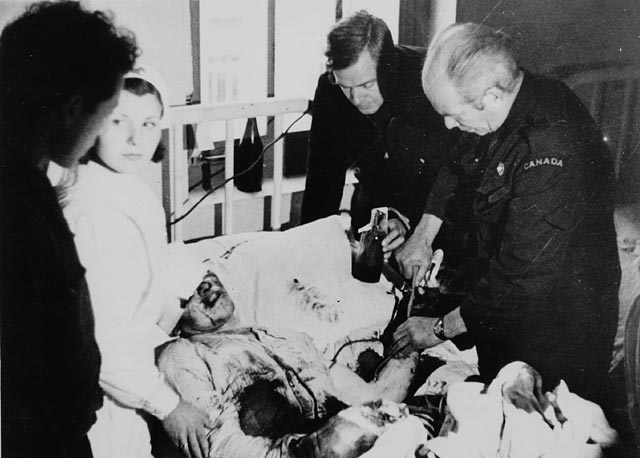
Dr. Norman Bethune, assisted by Henning Sorensen, performing a transfusion during the Spanish Civil War, ca. 1936-1938. Source: Library and Archives Canada/Mackenzie-Papineau Battalion collection/c067451
His Early Experiences
Norman Bethune is the most famous Canadian participant in the Spanish Civil War, although recognition of his contribution was slow in coming.
He was born in 1890 in Gravenhurst, Ontario (his home is now a National Historic Site and open to the public). In 1914, with 2 years left to go in his medical studies at the University of Toronto, he enlisted in the medical corpsin the First World War. He received a shrapnel wound in France and was returned to Canada, completing his medical studies two years later. Since the war was still on, he was able to return to active duty as a doctor.
After the war he embarked on a distinguished career in medicine. By 1936, when the Spanish Civil War started, he was an expert in the treatment of tuberculosis and the head of thoracic surgery at Sacre Coeur Hospital in Montreal. Bethune had visited the Soviet Union the year before to attend a conference and took the opportunity while there to tour hospitals and sanitariums. He was impressed by their universal health care system. That same year, back in Montreal, he was caught by chance in a police action against two thousand peaceful demonstrators. Many were injured by police clubs or trampled by horses. Bethune helped with medical aid and the next day began volunteer work among the city’s poor. He also joined the Communist Party of Canada during this time. When the Committee to Aid Spanish Democracy looked for a capable and committed surgeon to staff the medical unit they were sending to Spain Bethune was the logical choice.
It couldn’t have been an easy decision for the established 46-year old Bethune. The fact that fascism was alive and well in Canada and that he had been personally affected may have had something to do with his decision. A few weeks earlier, his apartment had been broken into and the walls defaced with swastikas. The police were uninterested.
Arrival in Spain
Upon his arrival in Spain, Bethune toured hospitals and the front noting the lack of transfusion services and the poor transport of the wounded. He quickly decided that organizing a mobile transfusion service would save many more lives than simply offering his skills as a surgeon. It was not easy to convince the conservative medical establishment in Madrid – who wanted him to work as a surgeon – that his proposal was necessary or practical but Bethune was thorough and persuasive. They eventually agreed and Bethune traveled to London and Paris to obtain and fit out a field ambulance, crossing the Pyrenees back into Spain on December 8, 1936 as the siege of Madrid entered its third month.
Formation of the Canadian Blood Services Unit
Bethune’s organizational skills were impressive. He quickly established a blood unit headquarters with a staff of ten, living quarters, labs, and blood storage rooms. A thousand blood donors were selected and regular runs to local hospitals were established. The next step was to extend the service to the front lines. A new ambulance was fitted out and Bethune and his assistants, Hazen Sise, a Canadian, and Tom Worsely, a British volunteer, set out for Malaga, a city on the Costa del Sol that had been attacked by Italian and Spanish troops and bombarded from air, sea and land.
Bethune had planned to provide blood transfusion services for the victims of the bombardment but found as he left the town of Almeira for Malaga that the 160km winding shore road joining the two cities was choked with refugees. The entire population of Malaga was on the move to Almeira – 100,000 inhabitants and 50,000 people that were already refugees from elsewhere in the south of Spain. Men, women, children, the fit, the wounded, the old, orphans were all struggling toward Almeira. Bethune realized that transport was of far greater importance than blood and immediately stripped the ambulance of all its equipment. For the next 3 days, the men worked in shifts to ferry the weakest into Almeira. Towards the end the column turned into women and children only – the remaining men had been machine gunned in mass executions on the beaches. The bombardment, the exodus and the mass murders were the first major atrocities against a civilian population. There would be more.
Bethune continued to enlarge the scale of the blood services and was soon supplying the entire Madrid front with a staff of 25. Through his efforts and organizational skills, he was able to bring the entire blood services on the Madrid front under a unified command.Death rates fell rapidly and hundreds, perhaps thousands of lives were saved. It was not just a successful humanitarian effort – it was also an expression of Bethune’s brilliance and foresight, creating medical and organizational innovation under harrowing conditions.
Unfortunately, there was a darker side to Bethune’s personality – he was often abusive to his harried and exhausted staff, impatient with the Spanish medical and governmental authorities and, increasingly, he drank too much. It was clear, now that the blood service had been established, that the Spanish establishment would be happy to see Bethune leave. They placed his organization under their direct control and before things could deteriorate further, the Committee to Aid the Spanish Democracy called him back to Canada in May 1937 to aid in their fundraising efforts.
Return to Canada
Bethune was a conscientious and successful fundraiser. He embarked on a gruelling cross-Canada speaking tour in summer 1937, with forays into the United States. Speaking in blunt and stirring language he inspired audiences while raising public awareness of the civil war and support for the fight against fascist forces. But by the fall of 1937, he had tired of the public campaign and wanted to get back into the field.
Spain, where he had ended things on poor terms by alienating the government, was closed to him. In China, however, Communist leader Mao Zedong was fighting a rearguard action against the Japanese. Bethune’s fame today is due in large part to his participation in China where he performed emergency battlefield surgical operations, while advising the Red Army on wartime medical care, and establishing training programs for doctors, nurses, and orderlies. Bethune died as a result of septicemia contracted during battlefield surgery. Thanks to a 1939 essay written by Mao (“In Memory of Norman Bethune”), he became a heroic figure in China. And his recognition in Canada was partly a result of this homage to the Canadian doctor. Bethune’s birthplace in Gravenhurst, Ontario is visited annually by large numbers of Chinese visitors.