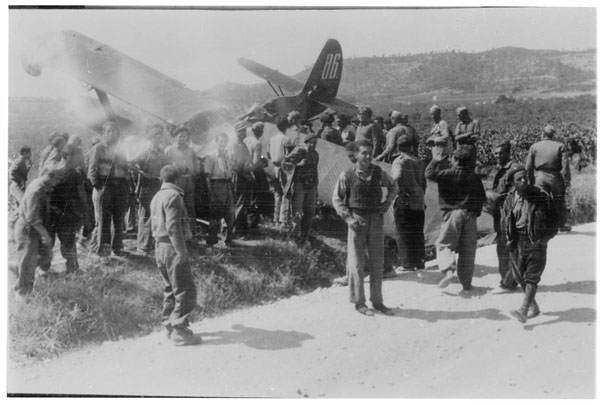
Source: Library and Archives Canada/Mackenzie-Papineau Battalion collection/e002712800
The Western approaches to Madrid pass through a broad valley 60 to 80 kilometers long and 15 to 25 kilometers wide. There are a number of towns of which Brunete is the largest, giving its name to the major battle that surged back and forth across the plain for 20 days in July 1937.
Since November 1936, Franco’s forces had occupied the towns on the plain and the Heights of Romanillos that flanked it. The government planned a major offensive against these forces by mobilizing ten divisions, one of which held the XIIIth and the XVth International Brigades.
On July 6th 1937, eight Republican divisions moved into position on the hills overlooking the valley and descended onto the plain where they met heavy fascist resistance. The XVth International Brigade composed of the Abraham Lincoln, the George Washington, the Dimitroff and the British Battalions was given the task of taking the village of Villanueva de la Canada (a curious coincidence for the 70-odd Canadians who participated, mostly in the Lincolns). They took the town after two days of heavy fighting.
From Villanueva de la Canada, the International Brigades advanced toward the Fascist positions on the Heights of Romanillos at a place called Mosquito Hill.
The Republicans had made rapid progress across the plain, but at the foot of the Heights the advance stalled. With the Battalions on the low ground and the Fascists dug in on the Heights, attack after attack up the slopes failed. On the 13th of July the assaults were abandoned and the two International Brigades were ordered into support for Spanish Republican units. After another three days of heavy fighting they were sent to the rear to recover.
Their respite didn’t last long. On July 16th, 1937 the Fascists mounted a major counter-offensive with 20,000 men, 100 tanks and 100 aircraft. The International Brigades were ordered back into battle as Franco’s forces swarmed down onto the plain forcing back the Republicans in a bitter action that lasted 8 days.
For a week the two forces fought desperately across the Brunete valley, battalions colliding and bouncing off one another to hurtle into another deadly engagement somewhere down the line – where there was a line. More often than not the fights were conducted on the run as the combatants clawed their way up and down the dried-out river corridors called barancas.
Gradually, the southern part of the Republican sector began to crumble. Brunete itself was captured after barrages of artillery shells literally smashed the town to pieces.
On the 26th of July the Republicans withdrew their forces. The four Battalions of the XVth Brigade had taken serious losses. The Lincolns’ commander was killed. The losses of the Lincolns and Washingtons were so great that the two Battalions were merged into the Lincolns. The Washingtons (as it turned out) were never reformed.
Of the 70 or so Canadians in the battle, one-third were killed and two successive leaders of the Canadian section in the Lincolns fell in a three-day period. A fourth leader would be needed before the battle was ended. While the Republicans had demonstrated their ability to deploy and maneuver at Army Corps level, they were simply unable to match Franco’s strength. They had thrown all of their forces into the battle on July 6 with virtually no reserve while the fascist forces were able to maintain a steady supply of fresh troops and armour and, in the middle of the battle, to stage a major counter-offensive. The uneven distribution of men and materiel and the effectiveness of German and Italian support to Franco had shown to disastrous effect.
After the Battle of Brunete, the Republicans re-evaluated their options. They planned an offensive in the northeast of Spain with the ultimate goal of taking Zaragoza, a strategic location for transport and with a supposedly anti-Fascist population. The northeast was also home to strongholds of the Spanish Anarchist movement and of the POUM (the Partido Obrero de Unificación Marxista), a radical Marxist party opposed to Stalinism. The hope was that heading there would allow the new government headed by Prime Minister Juan Negrín to start establishing control. This new path would take the Republicans through the smaller towns of Quinto, Belchite, and Fuentes de Ebro.
At the end of August, their armies marched on Quinto where a bloody and brutal battle with Franco’s troops broke out. But it was a victory for the International Brigades who had been deployed as shock troops. They marched on Belchite and after two weeks of vicious and costly house-to-house fighting they managed to take the town.
During this time the Mackenzie-Papineau Battalion had finished its training and joined the XVth Brigade. Their first action was to join the offensive on Fuentes de Ebro. The attack was a massacre. None of the Republican troops were able to advance more than a few hundred metres. The Mac-Paps managed to advance the farthest of any battalion before they too were halted by the onslaught. Those who were not killed took cover or played dead before returning to their lines by nightfall. Exact casualty numbers are not known, but many Mac-Paps were killed and wounded during this attack. Despite the high casualties, the Mackenzie-Papineau Battalion’s first battle earned them praise for their bravery.
The planned advance on Zaragoza was derailed by this defeat and so the XVth brigade was pulled out of the region. They returned to central Spain, deployed to small villages and occasionally given leave to go to Madrid.
The next Republican operation was to defend the city of Teruel from Franco’s forces in December. Teruel was a windy city and the International Brigades struggled traversing the surrounding mountains. The XVth Brigade eventually arrived in Argente, a nearby destroyed village, in January 1938. The Mac-Paps waited for action in the ruins of Argente itself. The conditions were very difficult in the winter weather and there were food shortages. After two weeks, they were deployed to join the direct offensive in Teruel. They held the line for as long as they could and fought admirably, but eventually the superior firepower of the Nationalists won out and the Republicans could no longer stop their advance. The XVth Brigade was pulled out and sent south.
However, the brigade was called back to service before starting their leave. The Mackenzie Papineau Battalion was ordered to try and capture Mount Atalaya, near Segura de los Baños, while the Lincolns captured another nearby hilltop. The Mac-Paps successfully took the hill by sneaking up to the Nationalist base and then assaulting their way forward with grenades. Afterwards they successfully took another hill, but without the element of surprise they sustained casualties. And though they managed to establish rough lines, their strength had been greatly diminished since the Battle of Teruel.
By March, the Republican forces in Aragón were severely impacted by a massive offensive by Franco’s army, aided by Italian and German forces and artillery. The survivors of this onslaught quickly retreated to the east. Many members of Republican army were confused about what to do and some began deserting. The Mackenzie-Papineau Battalion was also under fire in their position outside Segura de los Baños. By March 10, all Republican units, except the Mac-Paps, were withdrawn from the area and the bridge leading out was blown up. The Mac-Paps were not informed about the planned takedown of the bridge and held their position until night fell when they began retreating, eventually linking up with other Republican troops. One Mac-Pap machine-gun crew was left behind and covered the retreat of the others. Those left behind soon realized that they were trapped. The Finnish gunners in the unit bravely refused to leave their post without orders (which failed to reach them), while other members of the unit attempted to retreat, most being killed by Nationalist gunners. The only survivor, Percy Hilton, was taken captive and eventually confirmed that the Finnish gunners had been executed. He became the first Mac-Pap taken as a prisoner of war during the Retreats.
A Republican force including International Brigades made a short stand at Lécera and then started an orderly retreat to Albalate del Arzobispo. The surviving Mac-Paps covered the rear of the retreat, but as they reached the town the vicious reality of the Nationalist onslaught began to set in and they started to flee, running into the other units that were also in retreat. Eventually, the Nationalists paused their advance and the XVth Brigade bravely halted their retreat to take defensive positions. When the Nationalists did not come, the brigade was ordered to continue their retreat with the Mac-Paps covering the rear once again. Everyone was so fatigued, however, that they eventually lost track of each other.
Most Canadians ended up in Caspe, where they did not have long to regroup before the Nationalists advanced. The battle was desperate and brutal and despite many members of the Mackenzie-Papineau Battalion rallying, retaking some ground and taking some prisoners, they soon had to continue to retreat into the city. The International Brigades in Caspe defended the city in house-to-house combat. The highly revered Finnish-Canadian machine-gunner and Mac-Pap Captain, Niilo Makela, was mortally wounded at Caspe. After two days those who survived were evacuated and the remaining Canadians then retreated to Batea where they could finally take a moment to breathe.
The Mac-Paps were reinforced with the final draft of volunteers from home who were thrown into the midst of the chaotic situation currently befalling the Republican forces. The Canadians who had survived the retreats were in very poor condition to fight. By the end of March, however, the XVth brigade was sent out again, this time to counter the Nationalists as they headed toward the Mediterranean Sea. The Mackenzie-Papineau Battalion was ordered to take two hills along the highway from Gandesa to Calaceite. A patrol was dispatched to scout, followed by another group of Mac-Paps, and both were eventually captured by Nationalists who were posing as Americans. This group included their commissar Carl Geiser and Jules Paivio, who eventually became the last surviving member of the Mac-Paps. They were going to be executed by firing squad but the last-minute arrival of a Nationalist officer halted the execution because International Brigaders were useful bargaining chips for prisoner exchanges. The captured Mac-Paps were ultimately taken to prison camps, alongside the forty other Canadians taken prisoner during the Retreats.
The other Mac-Paps headed towards the sea and managed to find the Brigade headquarters. They continued to march east to Gandesa, engaged with a Nationalist tank forcing it back, and eventually slipping away to avoid further encounters with the enemy. In the chaos of the sometimes frantic escape efforts, exhausted and hungry, many lost contact with their units. It was treacherous and many Brigaders died or were taken prisoner. The remaining members of the Mackenzie-Papineau Battalion gathered on the east side of the Ebro River and joined up with the surviving International Brigades. They then established a rough defensive line along the east side of the river.
Things became quite tense between the leadership and the volunteers at this time. Some leaders did not understand why their plans had not come to fruition as they sat behind the lines, while the volunteers, drained by weeks of difficult fighting, rushed escapes and near starvation, were frustrated by this lack of understanding about what they had gone through.
In May and June, the International Brigades started rebuilding as the Nationalists began marching toward Valencia, a move that had slowed their progress and gave the Republicans a chance to regroup. They worked to replenish the Mackenzie-Papineau Battalion’s depleted numbers with young Catalan conscripts as recruiting had halted in Canada. The battalion was also very underequipped after all of the chaos, clothing and shoes being in particularly short supply. The battalions were re-organized, and attempts were made to re-build morale during this time, with a May Day festival and national celebrations on July 1st and July 4th, with sports competitions and other activities, and larger rations of food and wine. Military training also resumed.
The International Brigades were then given their next assignment, returning to the Ebro River and waging an offensive against the Nationalist forces there. The goal was to break through Franco’s path to the sea, reunite the divided Republic, and reverse the Nationalists’ forward momentum. The goal was to allow the Republic to hold out long enough for larger European geopolitics to shift against fascism. It was a risky move, but the Republican leadership felt it was their last chance.
The attack began after midnight on July 25, 1938, with thousands of Republican troops silently rowing, then marching over floating bridges, across the Ebro River. The Mac-Paps and other Internationals moved cautiously on the other side of the river, then quickly making their way through Nationalist territory. They made their way to Gandesa where they joined an offensive with the rest of the XVth brigade until they were halted east of the town. The Nationalists began to push back and, with the element of surprise gone, the Mac-Paps made assault after assault on the fascist forces, but without strong support or reinforcements. The offensive was met with intense fire from well-equipped Nationalist troops armed with the latest weaponry, including 88mm cannons, and dive-bombing airplanes. After brutal ten days, the survivors pulled back.
They regrouped and the brigade was then sent to Sierra de Pándols to try and maintain the advances that had been made in the previous weeks. The Canadians were sent to hold Hill 909. The conditions were scorching hot and there was little cover to be found as they endured relentless shelling. Despite the conditions, the Internationals managed to keep back the Nationalists who were also suffering from the lack of cover. After eleven days the surviving Mac-Paps withdrew and were replaced by Spanish Republicans, many of them quite young.
Rumours had started that the Internationals were soon to be sent home, with the war seemingly coming to a close. Despite the rumours, the XVth Brigade was sent to the front twice more, fighting for about a week before being sent to reserve positions. By September 21, the Spanish prime minster declared that all international volunteers were being withdrawn from the front. This news got back to the front lines and the Internationals knew if they could survive until reinforcements came they could go home.
The Mac-Paps were told to hold the lines for one more day. That day saw a barrage of attacks and Nationalist forces advancing towards them. They tried to hold back the onslaught, but were eventually overwhelmed. The first line retreated and the ones who made it to the second line were able to defend their positions for the rest of the day, despite many deaths and injuries.
After they left the fighting, those Canadians who were not in hospital began to be evacuated. They formed ranks one final time and then command of the XVth brigade was handed over to Spanish forces. Farewell parades and fiestas were held throughout Republican territory. In Barcelona Dolores Ibárruri (known as La Pasionaria), the Spanish Communist political leader, delivered her famous “You are legend” farewell speech to the International Brigades that has become emblematic of their struggle. Quotes from the speech are documented on many monuments and the text of the speech is included in the Poetry and Speeches section of this website.
It took a long time to organize evacuations and many Canadians became restless. Even as their American and British comrades were leaving, the Canadians remained. There was a lack of money to pay for their return to Canada. The Canadian Communist Party and the Friends of the Mackenzie-Papineau Battalion did not have funds to finance the return home. A.A. MacLeod acted on behalf of the Friends of the Mackenzie-Papineau Battalion (the organization in Canada that garnered support and funding for the Mac-Paps throughout the war and aided with demobilization) and worked to secure a deal to bring the volunteers home. He liaised with the Canadian government and Canadian Pacific steamships while travelling to London and Spain trying to raise money and organize the departure. They received money from a number of sources, including the Spanish Embassy in France and the Friends of the Abraham Lincoln Brigade and even industrialist George Weston. Most non-captured Canadians left Spain in January 1939, with a number still trapped in various locations who had to find their own way out. The bulk took a train to France and made their way by ship back to Canada. The prisoners of war were the last Canadians to leave Spain. Thirty-one were released in April 1939 when the war was done, and were taken to the French border. A few Canadians were left behind and held in prolonged detention for a variety of reasons eventually being released sporadically.
Upon return to Canada, despite scrutiny from the government during their travels, no veteran of the Spanish Civil War was tried under the Foreign Enlistment Act which had been passed to prevent Canadians from volunteering in the Spanish Civil War. Hundreds of volunteers had returned injured and the Friends of the Mackenzie–Papineau Battalion organized a rehabilitation fund to help pay for medical care. By April 1939, the organization reported 964 veterans required some level of medical care. The Friends organized a fundraising tour across the country to support rehabilitation. Most veterans went back to their normal lives, with many eventually enlisting in World War II to continue the fight against fascism that they started in Spain. Others continued advocating against the Francoist government in Spain.
By 1949, the Friends of the Mackenzie–Papineau Battalion disbanded partially due to Cold War anxieties around their affiliation with the Communist Party. This rising anti-communist sentiment in Canada also resulted in the veterans becoming more scrutinized and eventually becoming less organized through the 1950s and 1960s, even though the political affiliations of the veterans were quite varied.
By 1970, Canadian veterans of the Spanish Civil War in Western Canada began organizing again, forming a veterans organization. By 1977, an Eastern section of the organization was created. The veterans organization operated as a fraternal society for the veterans to maintain their relationships as well as an advocacy group to support anti-fascist causes. In 1979, veterans began mobilizing to gain official recognition from the Canadian government. They were advocating for the Foreign Enlistment Act to be amended to exempt their service in Spain and for their service to be considered equal with Canadian World War II veterans. This campaign led them to be recognized by two Spanish city councils, seven Canadian cities (Calgary, Ottawa, North York, Thunder Bay, Toronto, Vancouver, and Winnipeg), and the province of Manitoba, but they were never formally recognized by the Canadian government.
They continued the veterans organization and supported numerous projects including the creation of public monuments across Canada (Toronto, Victoria and Ottawa) and the 1989 publication of the book “Canadian Volunteers: Spain, 1936-1939” by Mac-Pap vet William Beeching about their experiences in Spain. Many veterans also returned to Spain for the 50th Anniversary of the Spanish Civil War in Madrid in 1986 and re-connected with other veterans of the International Brigades. The Veterans and Friends of the Mackenzie-Papineau Battalion have continued the work of honouring the contributions and legacy of the Canadian volunteers in the Spanish Civil War. Today, the organization carries on – through the Mackenzie-Papineau Memorial Fund- thanks to the heroic efforts and the sacrifices made by those who came before us.
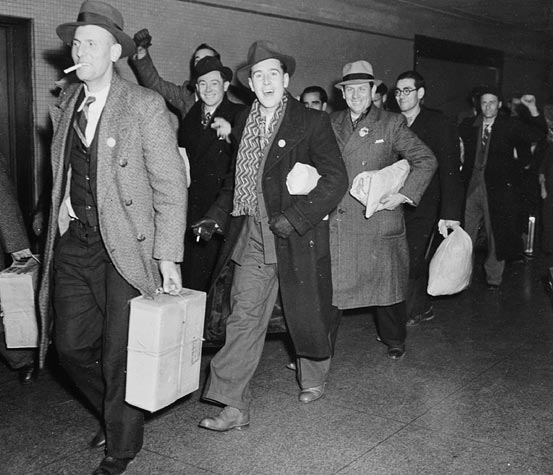
Source: Library and Archives Canada/Mackenzie-Papineau Battalion collection/c067458